


The Poetry Of WB Yeats
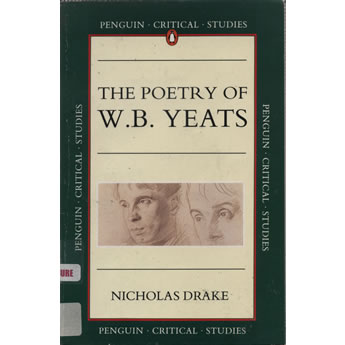
Publisher: Penguin
Format: Paperback
ISBN: 0140771328
The Poetry of W. B. Yeats (1991) – Nicholas Drake
Penguin
ISBN: 0140771328
Condition: Used, as delicately battered by Crappy Old Books.
Yes, it’s 2025 and you are still trying to understand what exactly W. B. Yeats was on about with the gyres, the swans, the rough beast, and all that business with Byzantium. Comfortingly, you are not alone. Enter The Poetry of W. B. Yeats by Nicholas Drake: a slim Penguin guide that exists precisely because even very clever people have stared at Yeats and thought, “Sorry… what?”
This is not the Collected Poems. This is the explain-it-to-me-like-I’m-smart-but-tired manual. It’s for those who can already quote “Things fall apart; the centre cannot hold” but would quite like to know what, specifically, is falling, why the centre is such a mess, and how this all relates to Irish nationalism, mysticism, and Yeats’s complicated love life.
What’s inside (besides interpretive heavy lifting)
Nicholas Drake very kindly:
-
Walks you through key poems
“The Second Coming,” “Easter 1916,” “Sailing to Byzantium,” “Leda and the Swan,” and the rest of the greatest hits, only now with context instead of pure confusion. -
Explains the symbols without the hand-waving
Gyres, birds, fire, water, revolution, old age, masks – all the recurring motifs get unpacked so you can stop bluffing and start understanding. -
Connects historical context to poetic meltdown
Ireland, politics, the occult, spiritualism, Maud Gonne, the end of the world (or several ends of the world)… all woven in so the poems stop feeling like riddles shouted from a distant hill. -
Offers actual analysis you can use
Whether you’re writing essays, teaching, revising, or just trying to stop feeling like Yeats is several steps ahead of you at all times.
It’s the literary equivalent of having a calm, well-read friend in the corner saying, “Right, here’s what he’s doing there,” while you underline things vigorously.
About the condition (poetically distressed)
This copy is Used, which at Crappy Old Books means:
-
The cover may show light scuffing, faint creases, or edge wear, like it has spent time in rucksacks, on desks, and perhaps under a stack of other Penguin paperbacks with equally intense feelings.
-
The spine is likely happily cracked, suggesting that at least one previous owner made it beyond page 7 and didn’t just buy it to look intellectual on public transport.
-
Inside, you may encounter:
-
Underlined passages where someone clearly decided, “Yes, this is going in the essay.”
-
Margin notes like “symbolism??” or “VERY IMPORTANT” or simply “wow”.
-
Pages that open naturally at the Big Poems, the ones that have doomed countless students to talking about “modernity” in exams.
-
In other words, it bears traces of prior Yeats-related struggle, which is honestly quite moving.
Why you might pretend you don’t need this (and totally do)
-
You’ve read the poems and think, “I get it… sort of?” but would prefer to feel at least 30% more confident.
-
You keep Googling interpretations and getting lost in 5,000-word essays about esoteric symbolism when what you really want is clear, sane explanation.
-
You like Yeats, but also suspect he sometimes turned the Obscurity Dial up to 11 just for fun.
-
You might have an exam, a dissertation, a lesson plan, or just a nagging sense of unfinished literary business.
This book is not here to replace Yeats – it’s here to stop you from quietly resenting him.
Why a Used copy is frankly ideal for poetry angst
Because:
-
A slightly worn Penguin guide looks exactly like it has already been through at least one existential crisis with someone else.
-
Any scribbles and underlining are bonus commentary, a ghostly chorus of previous readers saying, “Yes, you’re right to be stuck here.”
-
You don’t have to treat it like a delicate relic. You can:
-
Bend the spine.
-
Add your own notes.
-
Circle things.
-
Drop it in your bag between a notebook and a half-eaten biscuit.
-
If there’s a faint tea stain near a passage on “The Second Coming,” just accept that as a visual metaphor for the state of modern civilisation.
The sales pitch pretending to be cultural enrichment
The Poetry of W. B. Yeats by Nicholas Drake exists to prove that you can:
-
Admire Yeats
-
Understand Yeats
-
Talk about Yeats
without faking it, panicking, or constructing increasingly wobbly sentences about “universal themes.”
It gives you enough detail to be impressive, enough clarity to be confident, and enough structure that you can finally stop saying, “It’s… complicated,” every time someone asks what Yeats is really on about.
So here it is:
The Poetry of W. B. Yeats (1991) – Nicholas Drake, Penguin.
Slightly aged, structurally sound, academically useful, symbolically overqualified.
Proudly Used and faintly heroic, as sold by Crappy Old Books, anno 2025.
Buy it. Read it. And next time someone quotes “A terrible beauty is born,” you can nod, pause, and actually know what you’re talking about.
Keep browsing: See more Poetry books Other books by Nicholas Drake
